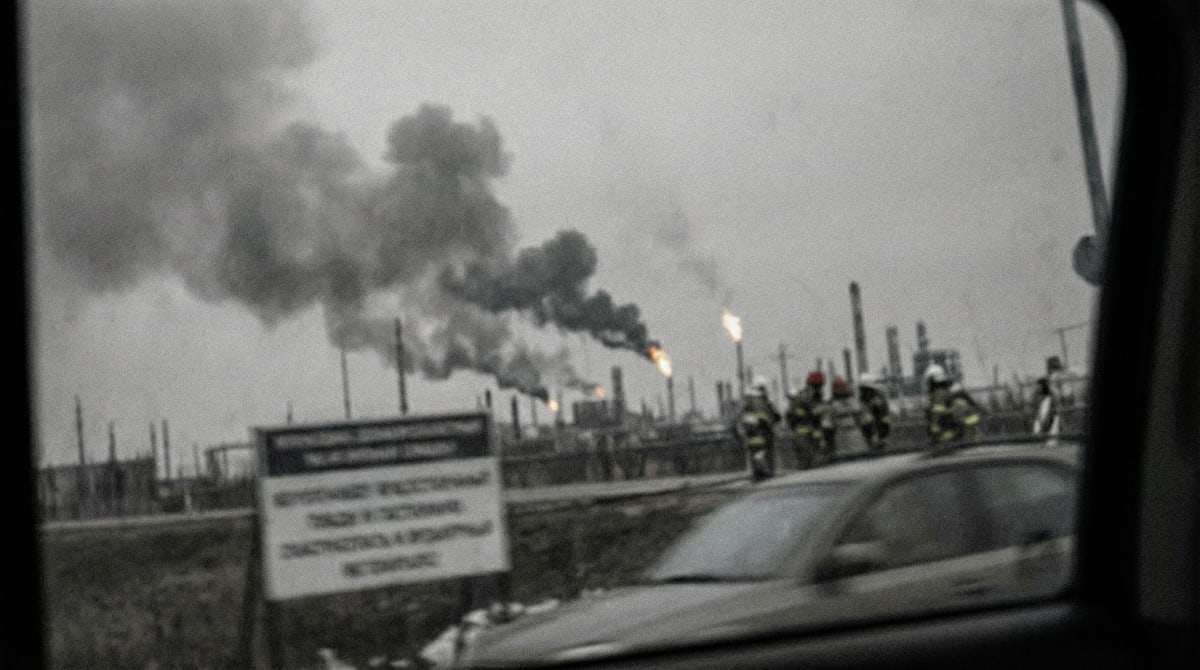
The analogy that keeps recurring in commodity markets when something breaks is always the same: a ship hitting a reef. The cargo spills, the harbor locks up, the supply lines fracture, and everything downstream gets queued up and waiting. What happened to Kharg Island in early March 2026 was not a single impact but something closer to a collision that has left the Persian Gulf's primary export terminal severely damaged and crude flows across the world cut by at least 8 million barrels per day.
TLDR
Kharg Island, Iran's primary export facility, has been severely damaged in attacks that have curtailed global crude production by at least 8 million barrels daily. The IEA released 400 million barrels from emergency reserves on March 11. Brent crude is trading near $92/bbl. For Australian consumers, petrol prices are climbing; for ASX-listed energy companies like Santos, Woodside, and Beach Energy, the windfall is real but temporary.
KEY TAKEAWAYS
The scale of the disruption is difficult to overstate. According to the IEA Oil Market Report for March 2026, Kharg Island typically handles roughly 30 percent of Iran's crude exports. When shipments through the Strait of Hormuz were disrupted by the attack and subsequent military tensions, the shortfall rippled across every major trading floor within hours. Brent crude, the global benchmark, climbed to approximately $92 per barrel by mid-March. The U.S. crude market, which relies on different supply dynamics, moved in tandem but with less dramatic velocity.
The numbers behind the crisis
Precision matters when discussing oil supply shocks. The IEA's March assessment reports crude production curtailed by at least 8 million barrels daily, with an additional 2 million barrels per day of condensates and natural gas liquids shut in. To put that in context: global crude consumption runs at approximately 100 million barrels daily across all uses. An 8 million barrel loss represents a reduction of roughly 8 percent of global supply, which is why traders moved so aggressively and why central banks began discussions about coordinating a strategic reserve release immediately.
The IEA membership, which includes Australia, agreed on March 11 to release 400 million barrels from their collective emergency reserves. This is the third-largest drawdown in the organization's history and signals the level of concern about sustained crude scarcity. The EIA Short-Term Energy Outlook projects Brent prices to remain above $95 per barrel in the near term, with settlement expected around $64 per barrel in 2027 as repairs progress and normalization takes hold.
What this means for the shape and duration of the shock depends entirely on repair timelines at Kharg and the degree to which shipping insurers and operators re-route traffic. A single damaged export facility can be brought back to partial capacity in weeks; full restoration might require months. The uncertainty itself is a price signal. Markets hate ambiguity about physical supply far more than they fear actual scarcity, because scarcity is knowable and manageable, while ambiguity forces traders to assume the worst case.
Australia's fuel price reckoning
Australian petrol consumers will feel this disruption directly, though the magnitude depends on variables that sit outside the energy markets themselves. Crude oil prices are quoted in U.S. dollars. Every dollar of AUD depreciation against the greenback adds pressure to Australian fuel prices at the bowser. Refining margins—the difference between crude input cost and refined product output—also matter significantly. Australian refineries typically operate on margins of $8–$12 per barrel. If those margins compress due to oversupply of refined products during demand weakness, the crude price shock gets partially absorbed rather than fully passed through. If margins widen because crude is scarce and refined fuels are in high demand, consumers bear the full brunt and then some.
The historical precedent is instructive. During the 1990–1991 Gulf War, when Iraq invaded Kuwait and crude futures spiked to $40 per barrel, Australian petrol prices rose sharply but recovered within months as the conflict resolved and supply normalized. The 2011 Libyan conflict—which removed 1.5 million barrels daily from markets for several months—saw sustained price elevation for three to four months. Kharg is a larger disruption and the timeline is less certain, which suggests Australian drivers should prepare for elevated prices through at least Q2 2026.
An 8 million barrel per day shortfall is not a marginal disruption. It is structural supply destruction that will take months to repair. The market is pricing in extended tight conditions.
— IEA Oil Market Report, March 2026
What this means for australian energy stocks
For companies listed on the ASX with exposure to crude prices, the Kharg disruption is a temporary but genuine earnings tailwind. Santos, Woodside Petroleum, and Beach Energy—the three major ASX-listed oil and gas producers—are all beneficiaries of the $92 Brent price environment. Santos produces roughly 90,000 barrels of oil equivalent per day. At $92/bbl, that translates to additional revenue of approximately $7 million per day compared to a $70/bbl baseline. For a company carrying substantial debt, as many Australian energy firms do, higher commodity prices represent a direct improvement in cash generation and balance sheet metrics.
Woodside's production base is smaller than Santos but similarly leveraged to Brent prices. Beach Energy operates on tighter margins and lower production volumes, but the math is the same: higher crude prices mean higher revenue. These are not technical analyses based on forward earnings models that might prove optimistic. This is simple cash flow mathematics: when the commodity price your core product sells at rises 30 percent in a week, your revenues rise 30 percent, all else equal.
The question these companies and their investors face is whether to regard the elevated price as durable or cyclical. History suggests cyclical. The last time crude sustained above $90 for an extended period was 2011–2014, and that proved to be a plateau that markets eventually broke through downward. Sustained crude prices in the high $80s to low $90s tend to attract investment capital into production, which increases supply, which eventually brings prices down. The fundamental physics of oil markets have not changed. Supply disruptions are always temporary because the economic incentive to repair infrastructure and increase production is enormous.
The strategic vulnerability question
What the Kharg disruption exposes, however, is something more durable than commodity prices: the strategic vulnerability of global energy infrastructure to concentrated shock. Kharg is a single point of failure for roughly 5 percent of global crude supply. The Strait of Hormuz, through which roughly 30 percent of global seaborne crude passes, remains one of the narrowest and most politically contested waterways in the world. The coincidence of these vulnerabilities—a single facility that handles an outsized share of supply, located in a region where military conflict is a baseline condition—creates a structural risk that commodity markets typically underprice.
For Australian policymakers and energy companies, this is worth contemplating. Australia has significant liquefied natural gas export capacity and growing renewable energy infrastructure, but crude oil remains a substantial import. A sustained disruption to Middle Eastern supply could create spikes in domestic fuel prices, with ripple effects across transport, agriculture, and manufacturing. The strategic reserve posture matters. Australia's emergency crude reserves are not on the scale of some OECD peers (the U.S. Strategic Petroleum Reserve holds 500+ million barrels; Australia's position is significantly smaller), which means the country is more exposed to sustained price shocks than larger economies.
The near-term outlook
Over the next 30 to 90 days, three factors will shape how the oil market and Australian consumers experience this shock. First, the pace of repairs at Kharg. If terminal capacity is restored to 50 percent within six weeks, the supply shock begins to ease. If repairs extend beyond that window, tightness persists. Second, the behavior of OPEC+ producers. Saudi Arabia and other major producers face a choice: maintain current production levels and let prices rise, or increase output to bring prices down. The incentives are complicated by geopolitics and production capacity constraints. Third, the global demand response. Higher crude prices suppress demand across the economy, which naturally brings supply and demand back toward equilibrium.
For Australian consumers, expect petrol prices at the bowser to remain elevated through Q2 2026, with gradual softening as summer ends and demand typically weakens. For ASX energy stocks, the windfall will be real through the remainder of this quarter and into the next, but it should not be mistaken for a structural repricing of energy markets. What broke at Kharg will be repaired, supply will normalize, and the commodity cycle will continue its inexorable long-term grinding downward, interrupted by periodic shocks that surprise no one and settle down quickly after all.
SOURCES & CITATIONS
FREQUENTLY ASKED QUESTIONS