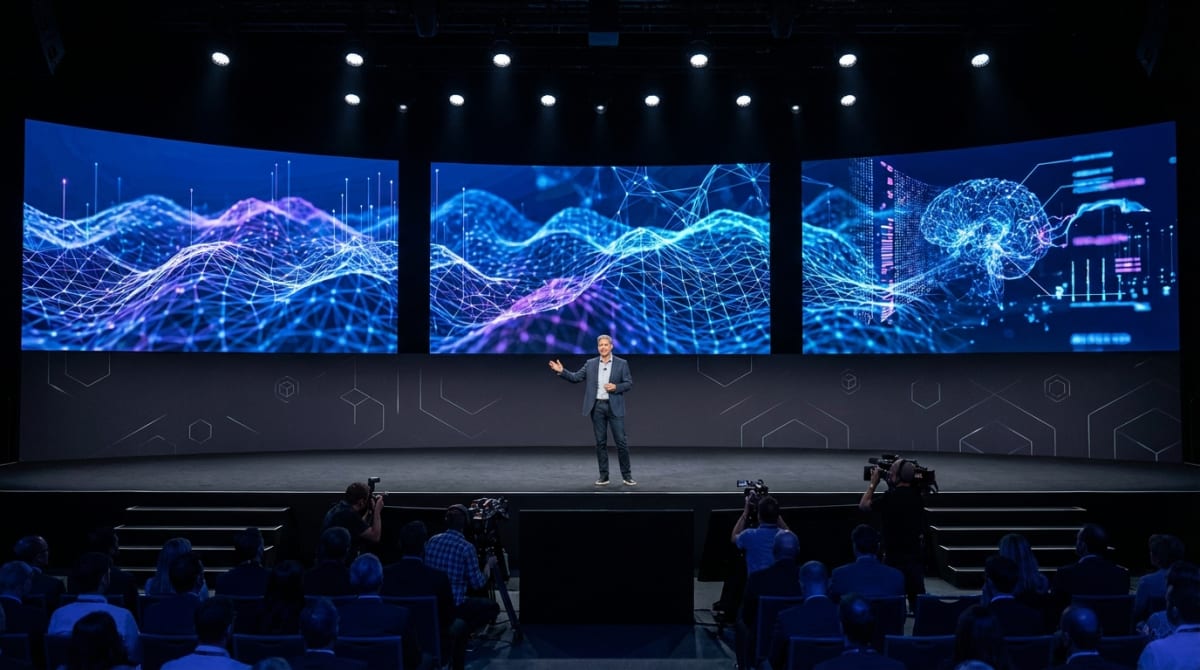
Nvidia CEO Jensen Huang proposed giving engineers artificial intelligence tokens in addition to their base salary at the company's GTC 2026 conference, describing a future where AI compute becomes a standard employee benefit.
TLDR
Nvidia CEO Jensen Huang proposed giving engineers AI tokens in addition to their base salary at the company's GTC 2026 conference. He said a $500,000 engineer should consume at least $250,000 worth of AI compute and envisioned Nvidia eventually employing hundreds of thousands of AI agents alongside its 42,000 human workers.
KEY TAKEAWAYS
Speaking to reporters, Huang said he would be deeply alarmed if a $500,000 engineer did not consume at least $250,000 worth of AI compute. When asked what he would do if that engineer reported using only $5,000, Huang said he would go ape something else.
The comments reflect Nvidia's view that AI agents will change how knowledge workers operate. Business Insider reported that Huang has suggested engineers should receive AI tokens equal to about half their annual salary.
AI agents at scale
CNBC reported that Huang envisions Nvidia eventually employing hundreds of thousands of AI agents alongside its 42,000 human workers. The AI agents would handle tasks ranging from code review to customer support.
The company has already begun deploying AI agents internally. Engineers use them to generate code, debug software and analyse data. Huang believes this is the beginning of a broader shift affecting all companies.
WinBuzzer reported that Huang proposed the AI token concept as a way to ensure engineers fully utilise available AI capabilities. The tokens would be budgeted separately from salary and could not be converted to cash.
Infrastructure demand
Fortune reported that Huang believes $1 trillion in AI infrastructure investment will not be enough to meet global demand. He said computing demand will continue to grow as AI agents become more capable and widespread.
The statement matches Nvidia's business interests. The company dominates the market for AI training chips and has seen revenue grow rapidly as technology companies build out AI infrastructure.
Huang said the AI token concept could become standard across the technology industry. Companies would compete for talent partly by offering larger AI compute budgets alongside traditional compensation.
Workforce implications
The proposal raises questions about how AI will affect employment. If engineers become more productive with AI assistance, companies may need fewer of them. Alternatively, higher productivity could enable engineers to tackle larger problems.
PYMNTS reported that Huang positioned AI tokens as an addition to base salary rather than a replacement. However, the long-term trajectory suggests AI agents could eventually perform tasks currently done by human workers.
Nvidia has not announced plans to implement AI tokens as formal compensation. Huang's comments appeared to be aspirational rather than describing an imminent policy change.
Industry reaction
The technology industry has responded with a mix of interest and scepticism. Some executives view AI compute budgets as a natural evolution of employee benefits. Others question whether the concept would work outside companies that build AI infrastructure.
Huang's comments came during a week where AI dominated technology news. Bezos announced plans for a $100 billion AI manufacturing fund, while Alibaba reported cutting 34% of its workforce as it pivots toward AI.
The convergence of these announcements suggests AI is moving from experimental technology to a central element of corporate strategy across industries.
GTC 2026 context
The GTC conference is Nvidia's flagship annual event where the company showcases new products and discusses industry trends. This year's event focused heavily on AI agents and their potential to work alongside human employees.
Nvidia announced several new products at the conference, including updated GPUs designed for AI inference and new software tools for building AI agents. The company continues to dominate the market for AI training hardware.
Huang's compensation proposal was one of several forward-looking statements that drew attention at the conference. He has built a reputation for making predictions about AI that subsequently prove accurate, lending weight to his views on the future of work.
Whether AI tokens become a standard benefit will depend on how quickly AI agents mature and whether other companies adopt similar approaches to Nvidia's internal deployment.
SOURCES & CITATIONS
- CNBC — Nvidia's Huang pitches AI tokens on top of salary as agents reshape how humans work
- Business Insider — Jensen Huang says he would be 'deeply alarmed' if his $500,000 engineer did not consume at least $250,000 of tokens
- Fortune — Nvidia's Jensen Huang thinks $1 trillion won't be enough to meet AI demand
- WinBuzzer — Nvidia CEO Jensen Huang Proposes AI Token Pay on Top of Salary
- PYMNTS — Nvidia CEO Jensen Huang Predicts AI Tokens Will Become a Standard Job Perk
FREQUENTLY ASKED QUESTIONS