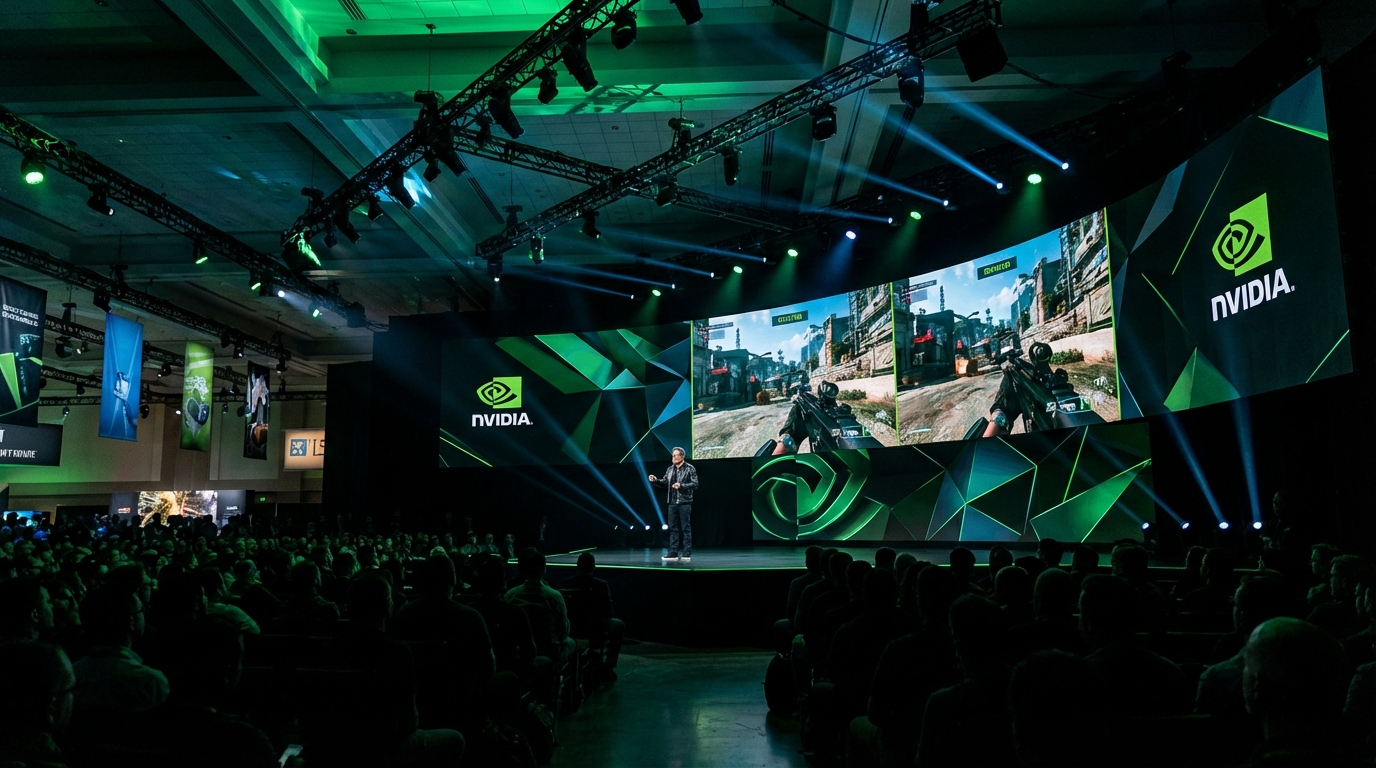
At GTC 2026 on March 16, NVIDIA unveiled DLSS 5, a technology the company positions as its most significant graphics innovation since real-time ray tracing arrived in 2018. The announcement came during Jensen Huang's keynote, where the CEO drew a direct comparison to the generative AI revolution that reshaped computing over the past three years.
TLDR
NVIDIA announced DLSS 5 at GTC 2026, introducing real-time neural rendering that adds photoreal lighting and materials to game frames. CEO Jensen Huang called it the company's biggest graphics breakthrough since ray tracing in 2018. Major publishers including Bethesda, Ubisoft, and Capcom have committed support, with titles like Starfield, Assassin's Creed Shadows, and Resident Evil Requiem confirmed. DLSS 5 launches this fall.
KEY TAKEAWAYS
"DLSS 5 is the GPT moment for graphics," Huang said. "Blending handcrafted rendering with generative AI to deliver a dramatic leap in visual realism while preserving the control artists need for creative expression."
What DLSS 5 actually does
Previous DLSS versions focused on performance: upscaling lower-resolution frames to higher resolutions, then generating entirely new frames to boost frame rates. DLSS 4.5, launched at CES 2026, reached a point where AI draws 23 out of every 24 pixels displayed on screen. The technology has been integrated into over 750 games.
DLSS 5 shifts the focus from performance to visual fidelity. The system takes a game's colour output and motion vectors as input, then applies a neural rendering model that adds photoreal lighting and materials in real time. According to NVIDIA's technical documentation, the AI model understands scene semantics including characters, hair, fabric, and translucent skin. It processes environmental lighting conditions and generates visually precise images that handle subsurface scattering on skin, fabric sheen, and light interactions with hair.
The key constraint NVIDIA had to solve: video AI models already generate photoreal pixels, but they run offline, lack precise control, and produce inconsistent results across frames. Games require deterministic output delivered in real time, tightly grounded in the developer's 3D world. DLSS 5 achieves this by anchoring its AI output to source 3D content, maintaining frame-to-frame consistency at up to 4K resolution.
The Hollywood gap
NVIDIA's framing of DLSS 5 centres on what it calls "the cinematic gap." A single game frame must render in roughly 16 milliseconds. A Hollywood VFX frame can take minutes to hours. That difference in compute budget explains why pre-rendered cinematics still look better than real-time gameplay in most titles.
The company has thrown substantial hardware at closing this gap. Since the GeForce 3 launched programmable shaders in 2001, NVIDIA claims a 375,000x increase in compute capability across its architecture generations. But brute force alone cannot match offline rendering. Neural rendering represents an attempt to bypass the problem entirely: rather than simulating every light interaction, train an AI model to recognise what photoreal lighting should look like and apply it.
Developer controls and integration
The risk with any AI enhancement is losing artistic control. A neural model that "improves" visuals according to its training data could override the specific aesthetic choices a developer made. NVIDIA addressed this directly: DLSS 5 provides controls for intensity, colour grading, and masking. Developers determine where and how enhancements apply.
Integration uses NVIDIA's existing Streamline framework, the same infrastructure that supports current DLSS and Reflex implementations. For studios already using DLSS 4.x, the upgrade path should be straightforward.
Publisher commitments
NVIDIA announced support from Bethesda, Capcom, Hotta Studio, NetEase, NCSOFT, S-GAME, Tencent, Ubisoft, and Warner Bros. Games. The confirmed game list spans major upcoming releases: Starfield, Assassin's Creed Shadows, Resident Evil Requiem, Hogwarts Legacy, The Elder Scrolls IV: Oblivion Remastered, Phantom Blade Zero, and Delta Force.
Todd Howard, studio head at Bethesda Game Studios, said DLSS 5 allows "the artistic style and detail to shine through without being held back by the traditional limits of real-time rendering." Jun Takeuchi at Capcom emphasised the technology's potential for atmospheric horror: "DLSS 5 represents another important step in pushing visual fidelity forward, helping players become even more immersed in the world of Resident Evil."
What this means for hardware
NVIDIA did not specify which GPUs will support DLSS 5. Given the computational requirements of real-time neural rendering at 4K, the feature likely requires RTX 50-series hardware or possibly high-end RTX 40-series cards. The RTX 5090, released in early 2025 with neural shader support, seems positioned as the baseline.
For Australian consumers, RTX 5090 pricing currently sits around $3,499 at local retailers. If DLSS 5 requires this tier of hardware, mass adoption will take years as prices decline and mid-range options emerge.
The competitive picture
AMD's FSR 3.1 and Intel's XeSS remain NVIDIA's primary competitors in upscaling, but neither has announced neural rendering capabilities. DLSS 5 could widen NVIDIA's lead in premium graphics features, assuming the technology delivers on its promises. The real test comes this fall when games ship with DLSS 5 support and independent benchmarks measure actual performance and visual improvements.
DLSS 5 arrives fall 2026. NVIDIA's full GTC keynote is available on its website.
SOURCES & CITATIONS
FREQUENTLY ASKED QUESTIONS