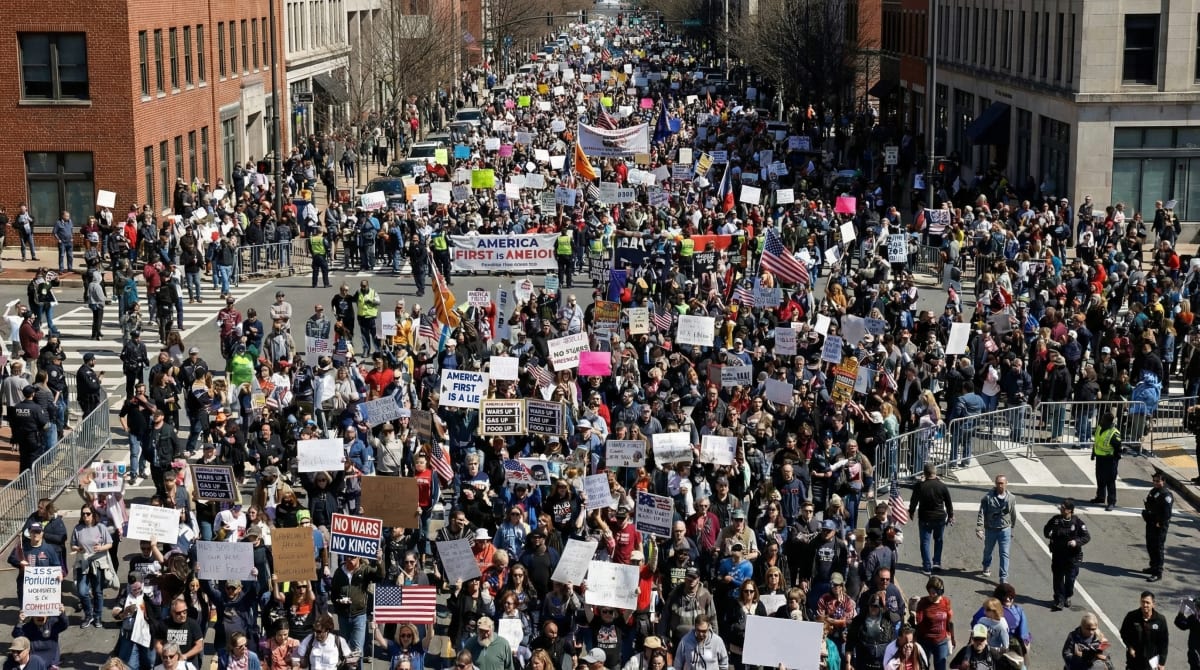
Minnesota Governor Tim Walz stood on the steps of the State Capitol in St. Paul on March 28 and told 200,000 people their state had become the epicenter of something larger than a protest. Behind him, upside-down American flags hung from scaffolding, the historical distress signal adopted by demonstrators across the country in the third No Kings rally. The crowd stretched six blocks in every direction while Bruce Springsteen prepared to perform.
KEY TAKEAWAYS
Your strength and your commitment told us that this was still America. And this reactionary nightmare, and these invasions of American cities, will not stand.
— Bruce Springsteen, performing at the Minnesota Capitol rally
No Kings organizers called the Minnesota rally the flagship event in their third and largest demonstration, with an estimated 8 million people filling streets in more than 3,300 locations across all 50 states. The scale makes March 28 the biggest single-day protest in US history, surpassing the 2017 Women's March by more than 3 million participants according to organizer estimates.
Beirut's port explosion protests in 2020 drew 300,000 from a city of 2 million residents. Saturday's demonstrations replicated that proportion across 50 different state jurisdictions, from New York City's 8.5 million residents to Driggs, Idaho, population 1,876. Covering street demonstrations across three continents over the past decade, the coordination required to mobilize this many people simultaneously without centralized command structures stands out as an organizational achievement separate from the political message.
Organizer counts and police confirmations
No Kings organizers estimated 5 million participants in June 2025, 7 million in October, and 8 million on March 28. Local police departments confirmed crowd sizes in major cities even as the national figure remains self-reported.
St. Paul Police shut down six blocks around the Capitol for what they estimated exceeded 200,000 attendees, more than the 100,000 who marched during the 2017 Women's March at the same location. LAPD arrested 37 people after deploying tear gas near a federal detention center downtown, while Denver Police declared an unlawful assembly and arrested eight after protesters blocked a road and threw smoke canisters back at officers.
San Diego Police counted 40,000 marchers through downtown, while Philadelphia officials shut down roadways for thousands more demonstrators converging on the city center. Chicago held a major rally at Grant Park organized by Indivisible Chicago and the ACLU of Illinois, and protests also filled streets in Little Rock, Portland, Boston, Houston, Detroit, and at least 40 locations across Southeast Michigan.
Organizers reported two-thirds of RSVPs came from outside major urban centers, including Idaho, Wyoming, Montana, Utah, South Dakota, Louisiana, and swing state suburbs in Pennsylvania, Georgia, and Arizona. Driggs, Idaho held a rally despite having fewer than 2,000 residents in a state President Trump carried with 66% of the vote in 2024.
Minnesota's role after federal shootings
Customs and Immigration Enforcement deployed tactical units to Minneapolis in February as part of aggressive enforcement operations the Trump administration launched across US cities. Renee Nicole Good and Alex Pretti, residents monitoring the operations, were both killed by federal agents in separate incidents.
Good, a community organizer, was shot outside a residential building in South Minneapolis on February 14, while Pretti, a videographer documenting ICE arrests, was killed on February 21 near the Hennepin County Government Center. Two federal agents fired their weapons in each incident, and congressional investigations into both shootings continue.
Minnesotans responded by staging daily counter-surveillance operations tracking ICE movements and warning residents. The state became what protest organizers described as "the front line of resistance to executive overreach."
Joan Baez performed at the Minnesota rally alongside Senator Bernie Sanders, actor Jane Fonda, and labor leaders from unions representing 800,000 workers. St. Paul Police estimated the crowd exceeded the 2017 Women's March, which drew 100,000 to the same location.
Gas prices as the economic catalyst
John Moes wore a 15-foot costume resembling Prince, the Minneapolis-born singer, to the St. Paul rally. Moes told reporters the reason he came was simple.
"Prices are going up, and it feels like we can't even afford to live anymore," Moes said. "This is one of the ways we can say we're fed up."
Gas prices averaged $5.20 per gallon nationally on March 28, up from $3.40 in January, according to AAA data. The increase followed disruptions in the Strait of Hormuz after the US launched air strikes against Iranian targets in February. Oil tanker traffic through the strait dropped by 60% in March while Brent crude hit $112 per barrel.
Signs at protests in Little Rock, Portland, and Washington referenced fuel costs. One woman in Little Rock carried a homemade MAGA sign reading "Morons Are Governing America," photographed by multiple news outlets at the Arkansas River crossing where more than 2,000 people marched.
Donna Lieberman, executive director of the New York Civil Liberties Union, spoke at the New York rally where thousands marched through Manhattan. "They want us to be afraid that there's nothing we can do to stop them," Lieberman said during a news conference. "They are wrong."
Multiple grievances converge
Protesters cited immigration enforcement as the primary issue. The Iran war and fuel prices ranked second. Rollback of transgender rights, restrictions on voting access, and diversity program eliminations also appeared on signs carried through city centers nationwide.
Hundreds marched past the Lincoln Memorial in Washington carrying signs reading "Put down the crown, clown" and "Regime change begins at home." Demonstrators rang bells, played drums, and chanted "No kings" while crossing the Memorial Bridge into the National Mall.
Bill Jarcho traveled from Seattle with six people dressed as insects wearing tactical vests labeled "LICE," a parody of ICE. "What we provide is mockery to the king," Jarcho told reporters. "It's about making fun of authoritarianism, which they hate."
White House calls protests 'therapy sessions'
The Trump administration dismissed the nationwide demonstrations within hours of their conclusion. White House spokesperson Abigail Jackson issued a statement calling the events products of "leftist funding networks" with "little real public support."
"The only people who care about these Trump Derangement Therapy Sessions are the reporters who are paid to cover them," Jackson said.
The statement did not address the specific policy grievances cited by protesters. It did not mention the 8 million participant estimate, the geographic spread across all 50 states, or the police-confirmed crowd sizes in San Diego, St. Paul, and other major cities.
What happens next
The first No Kings protests in June 2025 preceded congressional midterm momentum favoring Democrats. The 2018 Women's March contributed to a blue wave that flipped 41 House seats in November of that year. Democrats now need three seats to regain House control in November 2026. The Senate map still favors Republicans, but party strategists told reporters the prospect of flipping it has moved from "impossible" to "conceivable."
No Kings organizers plan a fourth round of demonstrations in June. The date has not been announced. Coordination will likely continue through grassroots networks rather than centralized leadership, the same decentralized structure that enabled 3,300 simultaneous events on March 28.
Gas prices remain the economic variable that could determine whether this movement translates into sustained political pressure or fades as a single-day expression of anger. Fuel prices above $5 per gallon through summer will maintain pressure on the administration from suburban voters in swing states. Prices below $4 remove the most tangible economic grievance driving middle-class participation.
Minnesota's role as the symbolic center forces Democrats into a strategic bind. Congressional Democrats must choose between defending aggressive immigration enforcement tactics they criticized under previous administrations or appearing soft on border security. The shootings of Good and Pretti created emotional rallying points while also creating a policy problem for elected Democrats navigating between progressive activists and centrist voters.
The scale of March 28 exceeded every previous US protest by at least 1 million participants. Whether those numbers translate into November turnout depends on factors that won't be measurable until late summer: gas prices, developments in Iran, and how many of those 8 million people who marched on Saturday will show up to vote in eight months.
TLDR
An estimated 8 million people demonstrated across more than 3,300 events in all 50 US states on March 28, making it the largest single-day protest in American history. Organizers cited the Iran war, gas prices at $5.20 per gallon, mass deportations, and voting restrictions as primary grievances. Minnesota hosted the flagship rally with Bruce Springsteen performing after two federal agents killed residents monitoring ICE operations.
SOURCES & CITATIONS
- CBS News - Millions turn out for 'No Kings' rallies held worldwide to protest against Trump (March 28, 2026)
- CNN - March 28, 2026 'No Kings' protests take place nationwide
- New York Times - Iran and Immigration Frustrations Fuel New Wave of 'No Kings' Rallies (March 28, 2026)
- NPR - Organizers say millions turned out for No Kings protests (March 28, 2026)
- AAA - National Average Gas Prices (March 2026)
FREQUENTLY ASKED QUESTIONS