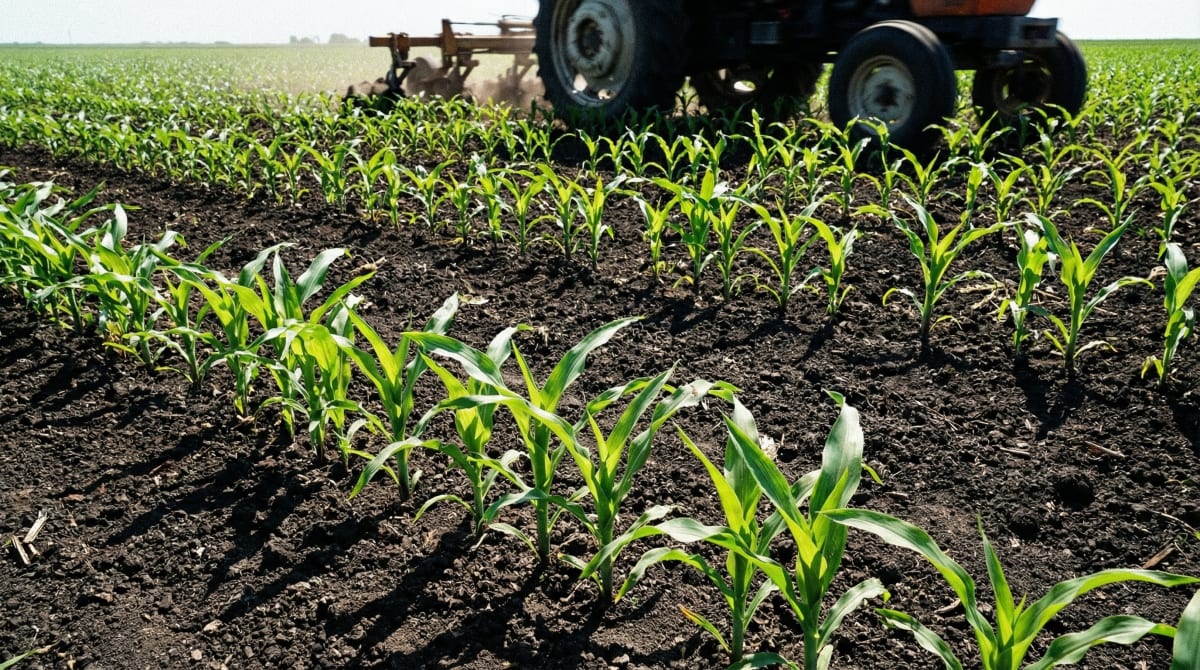
Randy Uhrmacher checked fertilizer prices in south-central Nebraska last week, and the numbers made him wince. "We're putting on some dry fertilizer right now," the farmer told Brownfield Agriculture News in early March, "and that hasn't gotten any cheaper."
KEY TAKEAWAYS
What he didn't know then was how much worse it would get. Urea prices at US Gulf ports hit $800 per ton by late March, up from $350 in December 2025. The Iran war closed shipping lanes carrying fertilizer from the Middle East and disrupted production across the Persian Gulf region.
The timing hits American farmers during the narrow window of spring planting season when corn and soybean operations apply fertilizer in March and April, leaving farmers unable to delay purchases while the crop calendar marches forward regardless of geopolitical crises.
What farmers are paying
Oxford Economics' Alpine Macro tracked price movements since the conflict began and reported urea surging roughly 50%, ammonia climbing 20%, and potash increasing 9% in a Monday analysis note.
DTN fertilizer price data from early March shows all eight major fertilizers trading higher year-over-year, with UAN28 nitrogen fertilizer jumping 33%, anhydrous ammonia and urea both rising 22%, MAP phosphate climbing 9%, and potash increasing 7% compared to March 2025 levels.
The USDA forecast fertilizer costs averaging $166 per acre for corn in 2026 when it released projections in January, marking a 5.3% increase from 2025, though the forecast predated the recent price spike and actual costs will run higher once March data gets incorporated.

Why Iran matters for fertilizer
The Middle East produces substantial nitrogen fertilizer exports through natural gas-rich countries including Iran, Saudi Arabia, Qatar, and Oman that operate large ammonia and urea plants, with Iran alone exporting over 5 million metric tons of urea annually before the conflict began.
War disrupted production and shipping through the Strait of Hormuz, which narrows to 21 miles at its tightest point and typically handles 20-30% of global seaborne trade in nitrogen fertilizers, while Houthi attacks in the Red Sea added further shipping disruption across the region.
Fertilizer tankers can reroute around Africa via the Cape of Good Hope, adding 3-4 weeks to shipping time and increasing freight costs, though some vessels aren't making the trip as insurance costs spiked and shipping companies pulled back from the region.
The compounding problem
Iran disruption compounds existing supply constraints left over from Russia and Belarus, which together supplied about 20% of global potash exports before Western sanctions limited trade flows following Russia's invasion of Ukraine, while natural gas prices in Europe remain elevated and raise production costs for European fertilizer manufacturers.
"The war in Iran sparks a global fertilizer shortage and threatens food prices," The Washington Post reported March 30. Higher fertilizer costs increase farming expenses. Farmers either absorb losses or pass costs through to food prices.
"South-central Nebraska farmer Randy Uhrmacher tells Brownfield costs are out of control," DTN reported in late March. "We're putting on some dry fertilizer right now, and that hasn't gotten any cheaper."
Break-even prices for US farmers without government support now sit at $4.70-$4.90 per bushel for corn and $10.80-$11.25 for soybeans, according to agricultural economists, while current market prices trade close to or below those levels in a calculation that doesn't work for most operations.
What happens next
American farmers will plant their crops. Farm operations run on debt secured against land and expected harvests. Missing a planting season equals defaulting on loans. Most operations will reduce fertilizer application rates rather than skip planting entirely.
"Each pound of nitrogen fertilizer produces roughly 50-60 pounds of corn under optimal conditions," USDA agronomists estimate. Cut fertilizer by 20% and yields drop proportionally. Lower yields tighten global grain supplies.
Food prices follow grain prices with a lag. Meat, dairy, and processed food costs reflect grain input costs. The price spike hitting farmers in March will show up in grocery bills by summer.
Developing countries including Egypt, Nigeria, and Pakistan face harder choices. They import large fertilizer volumes. Currency pressures and food subsidy programs leave governments with limited room to absorb price shocks.
"Fertilizer costs are expected to average about $166 per acre in 2026," the USDA forecast noted, "up 5.3% from 2025." That prediction came before the recent spike. Actual costs will run higher.
No quick fix
Fertilizer production capacity can't scale quickly. Building new nitrogen fertilizer plants takes 3-4 years and billions in capital investment. Existing plants already run near capacity.
Alternative shipping routes exist but add costs and time, and producers in North Africa and the Americas can increase exports to fill some gaps, though that approach leaves other regions short and triggers price competition across global markets.
The conflict timeline matters. Shipping disruption that resolves within weeks allows the supply shock to moderate. Extension through 2026 keeps fertilizer markets tight. Next year's planting season starts in March 2027. The window to rebuild depleted stocks is narrow.
Randy Uhrmacher and millions of farmers globally are calculating whether they can afford to plant at current fertilizer prices, and the answer they reach will determine food costs for everyone who buys groceries.
TLDR
Fertilizer prices have surged up to 50% since the Iran conflict began. Urea now costs over $800 per ton in the US Gulf, up from $350 in late 2025. American farmers planting corn and soybeans face higher input costs during spring planting season, with potential knock-on effects for global food prices.
SOURCES & CITATIONS
- War with Iran disrupts fertilizer exports as U.S. farmers prepare for planting season, NPR, 26 March 2026
- Fertilizer prices surge amid Iran war, sparking food security warnings, CNBC, 25 March 2026
- Most Fertilizers' Prices Continue Higher, 4 Considerably More Expensive, DTN Progressive Farmer, 25 March 2026
- Fertilizer Supply Crisis: Global Food Security Threatened as Prices Soar Amid 2026 Conflict-Related Disruptions, Financial Content Markets, 30 March 2026
FREQUENTLY ASKED QUESTIONS