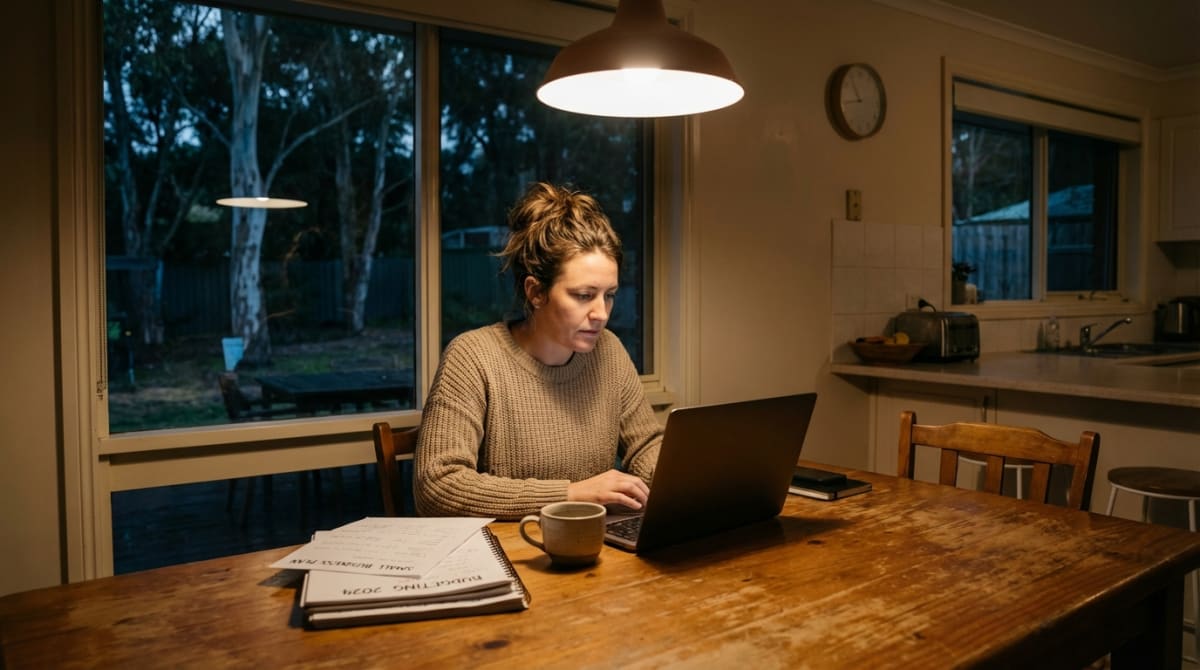
Workplace consultants have started noticing a shift in how people answer the question: what does financial security look like to you? Five years ago, the answers clustered around property, paid-off mortgages, maybe an investment apartment on the side. The order varied but the ingredients stayed constant.
TLDR
New research from Intuit shows 41% of Australians now see starting a business or side hustle as their primary wealth-building strategy for 2026. This beats both saving cash (39%) and seeking a pay rise (28%). With median house prices at $922,838 and a typical business startup costing $20,000, the maths has shifted for a generation locked out of property.
KEY TAKEAWAYS
Run the same exercise now and property barely rates. Instead, people talk about cash flow, multiple income streams, not being dependent on a single employer who could restructure them out the door next quarter. Something fundamental has changed, and the data released this week by Intuit confirms it.
The numbers behind the shift
The 2026 Entrepreneurship Report surveyed 1,500 Australians in December 2025 and found that starting a business or side hustle has become the country's most popular wealth-building strategy. Entrepreneurship beat out saving cash (39%) and seeking a raise or promotion (28%), with 41% of respondents naming it as their primary approach to building wealth.
The numbers reflect a loss of faith in traditional pathways. Wages grew 4.1% in the year to December 2025 while inflation ran at 3.4%, which left real wage growth at less than one percent. Getting a pay rise, if you can manage one, does not shift the numbers the way it used to, and saving into a bank account at term deposit rates of 4.5 to 5% barely keeps pace with inflation.
The median startup cost for a business sits at $20,000 according to the Intuit research, which looks modest against the 20% deposit required for the national median dwelling price of $922,838 (roughly $185,000). In Sydney, where the median house price exceeds $1.28 million, buyers need $256,000 saved before they can even begin talking to a lender.
We used to see people start businesses for passion; now they're doing it for empowerment. With the cost of living refusing to budge, Australians are using low-cost digital tools to build income streams that give them more control over their financial future.
— Ada Wang, Head of SMB, Intuit APAC
The side hustle economy is already here
The shift is already underway in living rooms and spare bedrooms across the country. 43% of Australians reported earning income from a side hustle in the past twelve months, with online selling accounting for 40% of these ventures. Freelance and contract work makes up 21%, while local services like cleaning, pet sitting, and tutoring account for 11%.
Most side hustlers spend between 11 and 20 hours per month on their venture. Earnings range from $100 to $999 per month for the majority. These are not numbers that replace a salary, but they represent something else entirely: agency.
HR leaders will recognise the underlying dynamic at play here: when employees feel stuck, when their effort does not translate into advancement, they either disengage and coast through their work or they leave entirely. What the side hustle data suggests is a third option: channelling energy elsewhere entirely while keeping the day job. The employment becomes the thing that pays the bills while the business becomes the thing that might actually pay off.
Only 21% of side hustles are registered as formal businesses, creating what researchers call an invisible economy. It also creates a compliance headache for accountants and the ATO, but that is a problem for another article.
Why property lost its magic
The Aussie dream used to follow a straightforward formula: work hard, save a deposit, buy a house, pay it off, retire comfortable. That formula worked when the median house cost four times the median income. Sydney now sits at 13.8 times the median household income, according to Demographia International Housing Affordability data. That places it in what they call the impossibly unaffordable category, with only Hong Kong ranking worse.
The average time to save a 20% deposit in Sydney is now roughly nine years, assuming you save 20% of your gross household income. Nine years of discipline just to reach the starting line, and once you get the mortgage, you need to service it at interest rates that have sat above 6% for most borrowers since 2023.
HR leaders across industries report the same pattern. Younger workers no longer ask about career paths to home ownership; they ask about flexibility to run their side projects, about four-day weeks, about remote work policies that let them live somewhere cheaper. The goalposts have moved because the old goals became unreachable.
AI is lowering the barrier to entry
Two-thirds of Australians say they will use AI tools to help launch or formalise a business in the next twelve months. The use cases run practical rather than exotic: generating business ideas, conducting market research, building websites, creating branding materials. Tasks that once required hiring a designer or spending weekends learning software can now be handled in an afternoon.
This matters because time and knowledge were historically the barriers that kept people from starting businesses alongside full-time work. If you needed a website, you either learned to code or paid someone $5,000. Logos and branding materials required the same investment. AI compresses that cost and time investment substantially. It does not make the business succeed, but it lowers the barrier to attempting one.
Dr Ben Hamer, an Australian futurist, has noted that AI is automating entry-level tasks in traditional employment while simultaneously enabling individuals to create, market, and scale operations that previously required entire teams. The same technology displacing junior roles is creating new pathways for side businesses.
The risks remain real
Despite the optimism, the barriers to starting a business remain substantial enough to give most people pause. Lack of capital tops the list at 43%, followed by fear of failure at 39%, time constraints at 24%, and insufficient business knowledge at 22%.
Those numbers align with patterns observable in corporate HR. The people who talk about starting businesses rarely do, while the people who actually launch them often stay quiet until the day they hand in their resignation with a half-built website ready to go.
Fear of failure cuts both ways in interesting ways. In a job, failure is often invisible: miss a deadline, get a performance conversation, keep the salary. In a business, failure is a negative bank balance. The risk asymmetry keeps many people stuck in contemplation rather than action.
And yet, 45% of Australians say they are prepared to start a business even if conditions are not ideal. 58% feel urgency to do so within the next year. There is impatience in these numbers that suggests people are no longer waiting for perfect timing.
What employers should be paying attention to
If 43% of the workforce earned side income last year, employers have a different employee base than they might think. These are not disengaged people waiting for retirement; they are people building optionality.
The companies that will retain talent in this environment are the ones that acknowledge the shift. Flexible arrangements matter more than ever, not as a perk, but as a baseline expectation. Employees who feel they have control over their time are less likely to resent the hours they spend at work.
The old retention model assumed that if you paid people enough and promoted them on a reasonable timeline, they would stay. That model also assumed property ownership as the incentive endpoint. If that incentive no longer functions for a generation that cannot reach it, employers need to offer something else. For many workers, that something else is time, time to build the thing that might eventually let them leave.
Employers may find this reality uncomfortable, but it is what the data shows.
The new Australian dream
What does wealth look like when property is off the table? The Intuit research points toward income you can control, skills you actually own, and independence from an employer in a labour market that can turn on you quickly.
Four in ten side hustlers say their goal is to turn their venture into full-time work, with most expecting to make that transition within one to two years. Whether they will actually succeed remains uncertain given that most businesses fail, but the attempt itself signals something about how Australians have started thinking about security.
When you put the median business startup cost of $20,000 next to the median Sydney house deposit of $256,000, one of those numbers feels achievable and the other feels like a lottery ticket. People are making rational decisions based on the choices available to them, and increasingly, those choices lead away from property and toward entrepreneurship.
SOURCES & CITATIONS
- Intuit QuickBooks 2026 Entrepreneurship Report (Australia)
- Your Mortgage - Median House Prices Around Australia March 2026
- Australian Institute of Health and Welfare - Housing Affordability
- The Guardian - Australian house prices expected to rise 5% in 2026
- Accountants Daily - How accountants can adapt to the new Aussie dream of entrepreneurship
FREQUENTLY ASKED QUESTIONS