
TLDR
The four-person Artemis II crew set a new human spaceflight distance record on April 6, 2026, reaching 252,756 miles from Earth and surpassing the mark Apollo 13 astronauts set in 1970. The mission, named Integrity, also gave the crew a ringside view of a solar eclipse visible only from behind the Moon. Splashdown is scheduled for April 10 off the coast of San Diego.
KEY TAKEAWAYS
- Artemis II reached 252,756 miles from Earth on April 6, 2026, beating Apollo 13's 1970 record of 248,655 miles by roughly 4,101 miles.
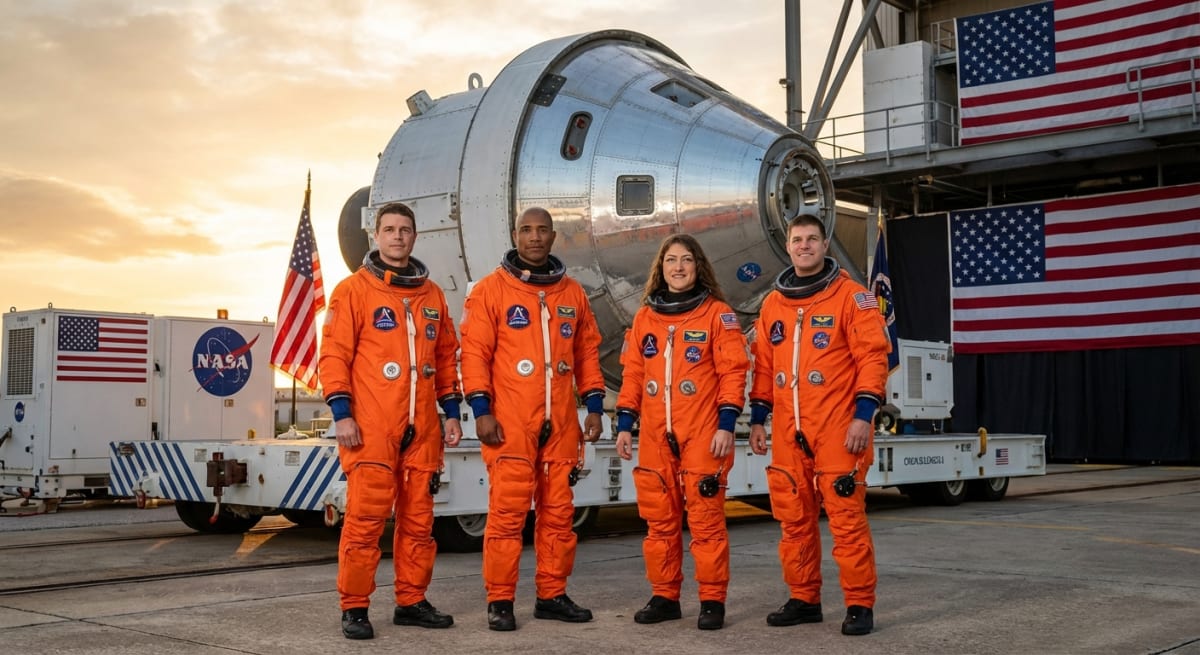
- Commander Reid Wiseman, Victor Glover, Christina Koch, and Canadian astronaut Jeremy Hansen make up the four-person crew aboard the Orion capsule named Integrity.
- The crew observed a total solar eclipse from behind the Moon, spotted four planets with the naked eye, and saw confirmed meteor impact flashes on the lunar surface.
- Apollo 13 astronaut Jim Lovell recorded a greeting before his death; ground controllers played it as Integrity crossed into record territory.
- Splashdown is targeted for April 10 at approximately 8:07 p.m. EDT off San Diego, wrapping a roughly ten-day mission launched April 1 from Kennedy Space Center.
Reid Wiseman, Victor Glover, Christina Koch, and Jeremy Hansen became the farthest-traveling humans in history at 12:56 p.m. CDT on Monday, April 6, 2026, as the Artemis II capsule Integrity sailed past the mark where Apollo 13 had turned back 56 years ago.
Integrity reached a peak of 252,756 miles, or 406,771 kilometres, from Earth. Apollo 13 had reached 248,655 miles in April 1970, a mark that held for 54 years. Artemis II cleared it by about 4,101 miles.
Jeremy Hansen, Canada's first deep space traveller, spoke from the cabin as the ship crossed the threshold. Hansen said the crew honored those who had gone before them. "This generation and the next," Hansen said, should make sure this record does not stand for long.
It is blowing my mind what you can see with the naked eye from the moon right now. It is just unbelievable.Jeremy Hansen, Canadian Space Agency astronaut
Reid Wiseman is serving as commander, Victor Glover as pilot, and Christina Koch as mission specialist. The four launched from Pad 39B at Kennedy Space Center, Florida, on April 1 aboard a Space Launch System rocket.
A message from Jim Lovell
Jim Lovell, the Apollo 13 commander who died earlier this year, had recorded a message for the Artemis II crew ahead of the mission. Ground controllers played it as Integrity crossed into record territory.
Welcome to my old neighborhood!Jim Lovell, Apollo 8 and Apollo 13 commander, pre-recorded message
Jim Lovell, speaking from decades of personal experience with the lunar neighborhood, told the crew to enjoy the view and use the mission as a stepping stone toward Mars.
Reid Wiseman said the crew had been moved by the gesture. "It's just a real honor to have that on board with us," Wiseman said, referring to a silk patch from Apollo 8 also carried aboard Integrity. "Such a majestic view out here," Wiseman said earlier, as the Moon filled the window for the first time.
Lunar flyby and the eclipse
Integrity came within 4,067 miles of the lunar surface at 7:00 p.m. EDT on April 6. The capsule reached its farthest point from Earth two minutes later, at 7:02 p.m.
During that passage, the Sun moved behind the Moon from the crew's vantage point, producing a total solar eclipse not visible from any point on Earth. The event lasted roughly an hour. Ground controllers lost contact for about 40 minutes while Orion passed behind the Moon.
It just looks unreal. You can see the surface of the moon against the Earthrise.Victor Glover, NASA astronaut, describing the solar eclipse
Christina Koch said the view of the lunar landscape caught her off guard. "Something just drew me in suddenly to the lunar landscape and it became real," Koch said.
Victor Glover, Christina Koch, Jeremy Hansen, and Reid Wiseman spent seven hours photographing the Moon and Earth with Nikon cameras and iPhones during the flyby. Apollo 12 and Apollo 14 landing sites were visible in the terrain below.
What the crew saw
Mercury, Venus, Mars, and Saturn were all visible with the naked eye during the seven-hour window. Aboard Integrity, the crew also confirmed at least four separate meteor impact flashes on the lunar surface.
Reid Wiseman described the view for those following along from Earth. "Cannot get enough of this," Wiseman told ground controllers.
Reid Wiseman also asked ground controllers to formally designate two unnamed craters. One would carry the name Integrity, after the capsule. The second would be named Carroll, in memory of Wiseman's late wife.
Mission context and what comes next
Artemis II is the first crewed Artemis flight. No astronaut will land on the Moon on this mission; that step is planned for Artemis III, which NASA has not given a firm launch date.
Integrity is covering roughly 695,081 miles from launch to splashdown. Splashdown is targeted for approximately 8:07 p.m. EDT on Friday, April 10, off the San Diego coast.
Dr. Lori Glaze, NASA's acting associate administrator for science, said the mission carries weight beyond the distance figure. "Their dedication is about more than breaking records," Glaze said. "It's fueling hope for a bold future. Their mission carries the promise to return to the Moon's surface, this time to stay."
Christina Koch, asked to describe the journey in a single word as Integrity prepared to come home, said: "Humility."
SOURCES & CITATIONS
FREQUENTLY ASKED QUESTIONS