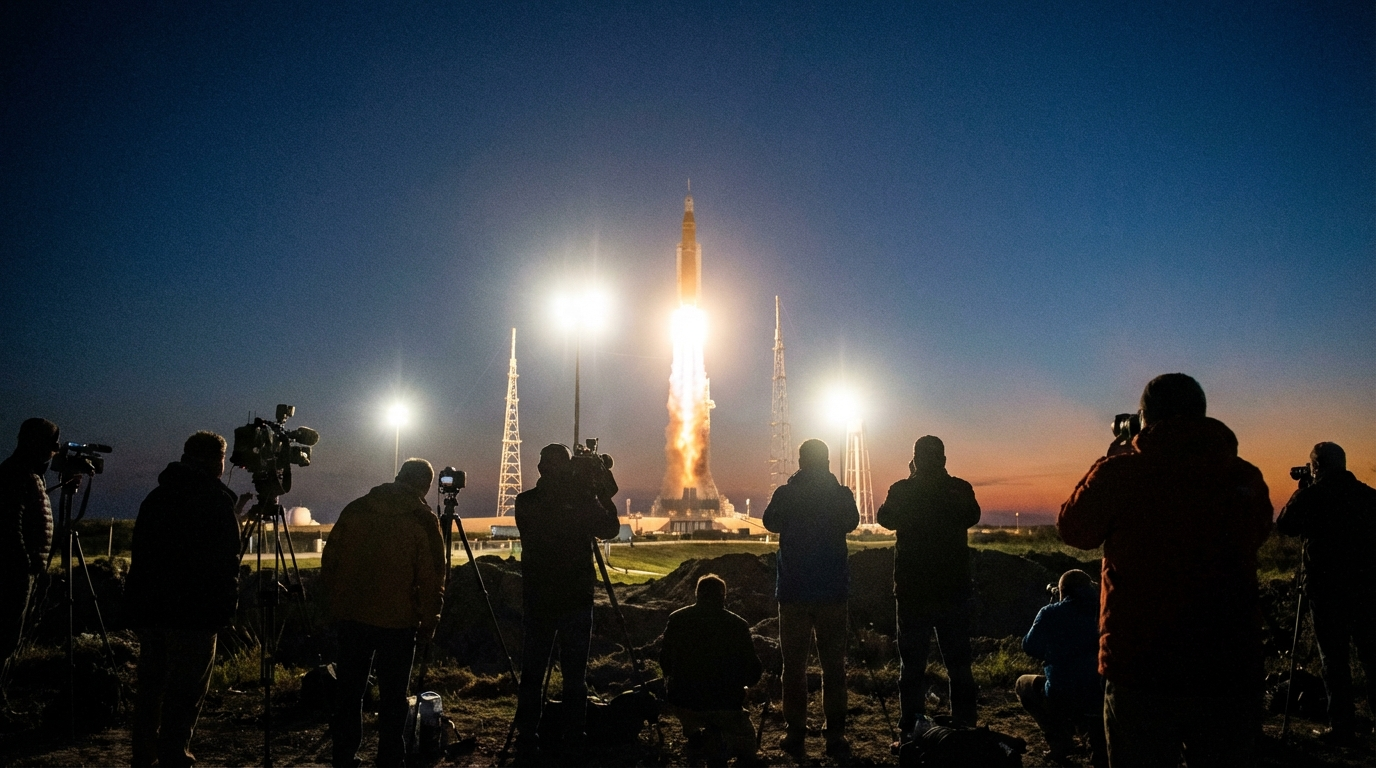
HOUSTON - NASA's Artemis II crew completed a burn Thursday that placed their Orion spacecraft into a high Earth orbit extending 46,000 miles beyond the planet's surface, the agency said.
TLDR
NASA astronauts Reid Wiseman, Victor Glover, Christina Koch and Canadian astronaut Jeremy Hansen completed the first major burn of their 10-day lunar flyby mission Thursday, placing their Orion spacecraft into high Earth orbit. The crew will conduct a second burn Friday to break free of Earth's gravity and begin the journey to the Moon. It is the first crewed lunar mission since Apollo 17 in December 1972.
KEY TAKEAWAYS
Reid Wiseman, Victor Glover, Christina Koch and Canadian Space Agency astronaut Jeremy Hansen conducted the six-minute engine firing with mission controllers at Johnson Space Center in Houston watching from the ground.
"Orion and its crew accelerated to break free of Earth's orbit," NASA said in a statement released Thursday afternoon. Wiseman commands the mission, with Glover serving as pilot and Koch and Hansen as mission specialists.
Orion, which the crew named "Integrity," separated from the Space Launch System rocket's upper stage about 49 minutes after liftoff on April 1. Argentina, Germany, South Korea and Saudi Arabia each deployed one small satellite from the upper stage several hours later.
Translunar Injection Scheduled for Friday
Johnson Space Center mission controllers will command the spacecraft's European-built service module to conduct the translunar injection burn on Friday, April 2, if systems remain healthy. Lunar gravity will slingshot the crew around the Moon and back to Earth during the six-minute firing.
Wiseman, Glover, Koch and Hansen will spend Thursday in high Earth orbit conducting a manual pilot demonstration. Kshatriya told reporters the test flight's purpose is to prove the vehicle's systems before crews land on the lunar surface.
"The team that built this vehicle, repaired it, and prepared it for flight has given our crew the machine they need to go prove what it can do," Kshatriya said Wednesday after the launch. "Over the next 10 days, Reid, Victor, Christina, and Jeremy will put Orion through its paces."
Lunar Flyby on Monday
Wiseman, Glover, Koch and Hansen will photograph the Moon's surface during a planned multi-hour flyby on Monday, April 6. Shadows will stretch across the lunar far side, revealing depth, ridges and crater rims that full illumination obscures, NASA said.
Koch will become the first woman to fly into cislunar space, the area between Earth's orbit and the Moon. Glover will become the first person of colour.
Gene Cernan and Harrison Schmitt last orbited the Moon in December 1972 aboard Apollo 17. No human has travelled beyond low Earth orbit in the 54 years since.
Test Flight Before Lunar Landing
NASA's Artemis III mission will attempt a lunar landing in 2027. The agency plans to establish a permanent presence on the Moon as a stepping stone to future Mars missions.
Isaacman said Wednesday the mission "marks our return to the Moon, not just to visit, but to eventually stay on our Moon Base." He called it "the foundation for the next giant leaps ahead."
Wiseman, Glover, Koch and Hansen will splash down in the Pacific Ocean after the lunar flyby. Total mission duration is approximately 10 days.
NASA expects the next scheduled communication from the crew Friday morning ahead of the translunar injection burn.
SOURCES & CITATIONS
FREQUENTLY ASKED QUESTIONS