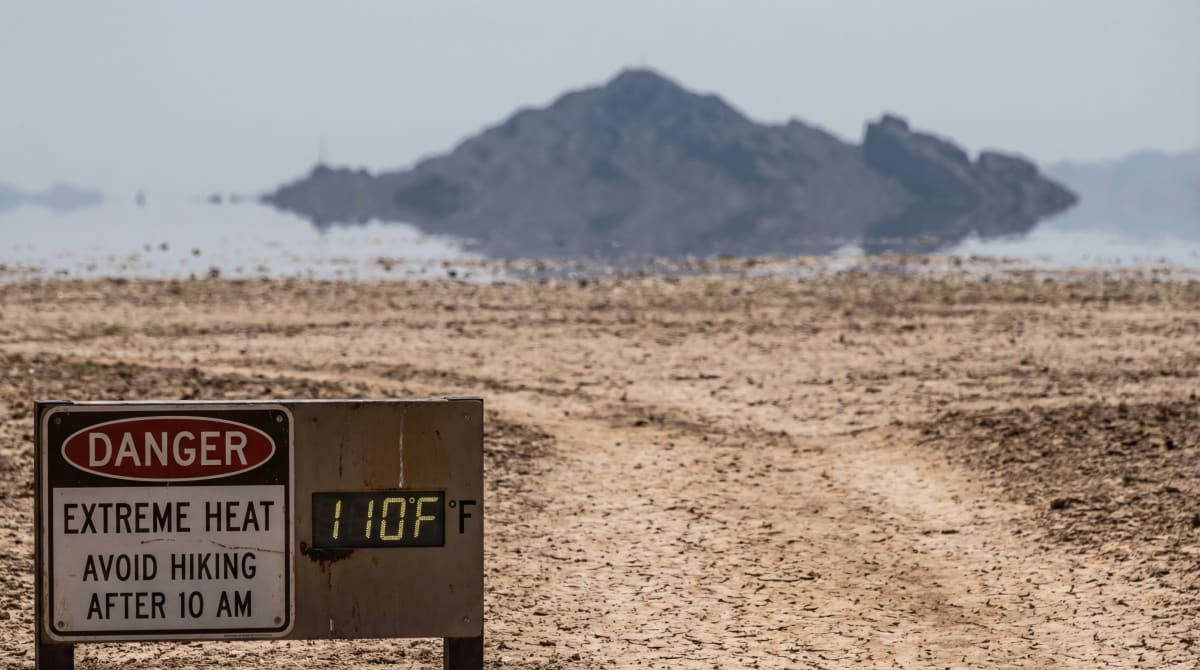
A desert community in southwestern Arizona recorded 110°F (43.3°C) on March 19, shattering the record for the hottest March temperature ever documented in the United States. The reading, taken just outside Martinez Lake in the Yuma Desert, surpassed the previous record of 108°F set in Rio Grande City, Texas, in 1954.
TLDR
A small Arizona community near Yuma hit 110°F (43.3°C) on March 19, 2026, setting a new record for the hottest March temperature ever recorded in the United States. Phoenix reached 105°F the same day, arriving at summer temperatures two full months ahead of schedule. Climate scientists conducting rapid attribution analysis concluded the event would have been virtually impossible without human-caused warming.
KEY TAKEAWAYS
The record fell on the last full day of winter. For context: Phoenix typically sees its first 100-degree day around May 10. The first 105-degree day usually arrives on May 22. This year, Phoenix hit 105°F on March 19, arriving at summer temperatures more than two months ahead of schedule.
Scale of the anomaly
Martinez Lake sits about 145 miles west of Phoenix, on the Arizona-California border. The community recorded temperatures roughly 25 degrees above normal for mid-March. The previous US record holder, North Shore in California's Coachella Valley, had tied the 1954 mark just the day before. The record stood for less than 24 hours.
Phoenix reached 105°F on Thursday, eclipsing the previous March 19 record of 97°F set in 2017 by a margin of eight degrees. The day before, Phoenix had hit 102°F, setting a new March 18 record. Consecutive daily records across three days, each breaking the previous by substantial margins, suggest something beyond ordinary variability.
This is what climate change looks like in real time: extremes pushing beyond the bounds we once thought possible. What used to be unprecedented events are now recurring features of a warming world.
— Andrew Weaver, climate scientist, University of Victoria
Attribution analysis
World Weather Attribution, an international consortium of scientists who study the causes of extreme weather events, released a rapid analysis on Friday. The group compared observed temperatures to what would have been expected in a world without human-caused climate change. Their conclusion: events as warm as those observed in March 2026 would have been virtually impossible without anthropogenic warming.
The analysis found that human-caused warming added between 4.7°F and 7.2°F (2.6-4°C) to the temperatures felt during this event, a margin large enough to transform an uncomfortable heat wave into a dangerous one. Without the additional warming, temperatures would have remained within historical parameters. With it, temperatures pushed into dangerous territory, prompting trail closures at Camelback Mountain and other Phoenix-area hiking destinations.
What we can very confidently say is that human-caused warming has increased the temperatures that we're seeing as a result of this heat dome, and it's going to be pushing those temperatures from what would have been very uncomfortable into potentially dangerous.
— Clair Barnes, attribution scientist, Imperial College London
Regional scope
The Arizona records were the most extreme data points in a broader heat dome that smashed records across the American Southwest. Palm Springs, California reached 107°F on Thursday, setting a new March record. The previous Palm Springs March record of 105°F had been set just one day earlier. Los Angeles, San Diego, Las Vegas, and San Francisco all recorded new highs for the date.
From a meteorological perspective, heat domes of this intensity in March remain rare. The setup requires a strong ridge of high pressure to settle over a region, trapping heat and preventing cooler air from entering. Such systems typically develop in July and August when surface heating is at its peak. Seeing one in March, with this intensity, is unusual in the historical record.
The National Weather Service expects temperatures to remain elevated through the weekend before moderating early next week, with Phoenix potentially reaching 106°F on Friday. Thermal, in California's Imperial Valley, was forecast to hit 110°F, potentially tying the new national March record set in Arizona.
Trend lines
The March 2026 heat wave fits a broader pattern of escalating extremes. According to NOAA's Climate Extremes Index, the area of the United States experiencing extreme weather in the past five years has doubled compared to 20 years ago. The metric includes heat waves, cold snaps, downpours, and drought.
An analysis of NOAA records shows the United States is breaking 77% more hot weather records now than in the 1970s, and 19% more than the 2010s. The frequency of billion-dollar weather disasters, adjusted for inflation, has roughly doubled in the past decade compared to ten years prior, and quadrupled compared to 30 years ago.
Craig Fugate, who directed FEMA until 2017, noted that infrastructure was designed around roughly 100 years of historical weather data. That assumption, he said, is starting to break. The clearest signal of changing risk calculus is not the scientific debate but the behaviour of insurers, who are increasingly withdrawing coverage from high-risk areas.
Global parallels
Stanford climate scientist Chris Field placed the March 2026 Southwest heat wave in a category of extreme anomalies that includes the 2021 Pacific Northwest heat dome, the 2022 Pakistan floods, and Hurricanes Helene, Harvey, and Sandy. Similar events, he noted, are occurring with increasing frequency across different regions and different seasons.
For residents of Phoenix and the broader Southwest, the immediate concern is adjusting to summer conditions arriving in spring. Trail closures remain in effect at multiple hiking destinations. The Maricopa County Department of Public Health issued a heat advisory urging residents to limit outdoor activity, stay hydrated, and check on elderly neighbours.
The Arizona records will likely be certified by NOAA in the coming weeks, pending routine verification of monitoring station data. What is already clear is that March 2026 will enter the climate record as another marker in the changing baseline of American weather.
SOURCES & CITATIONS
FREQUENTLY ASKED QUESTIONS