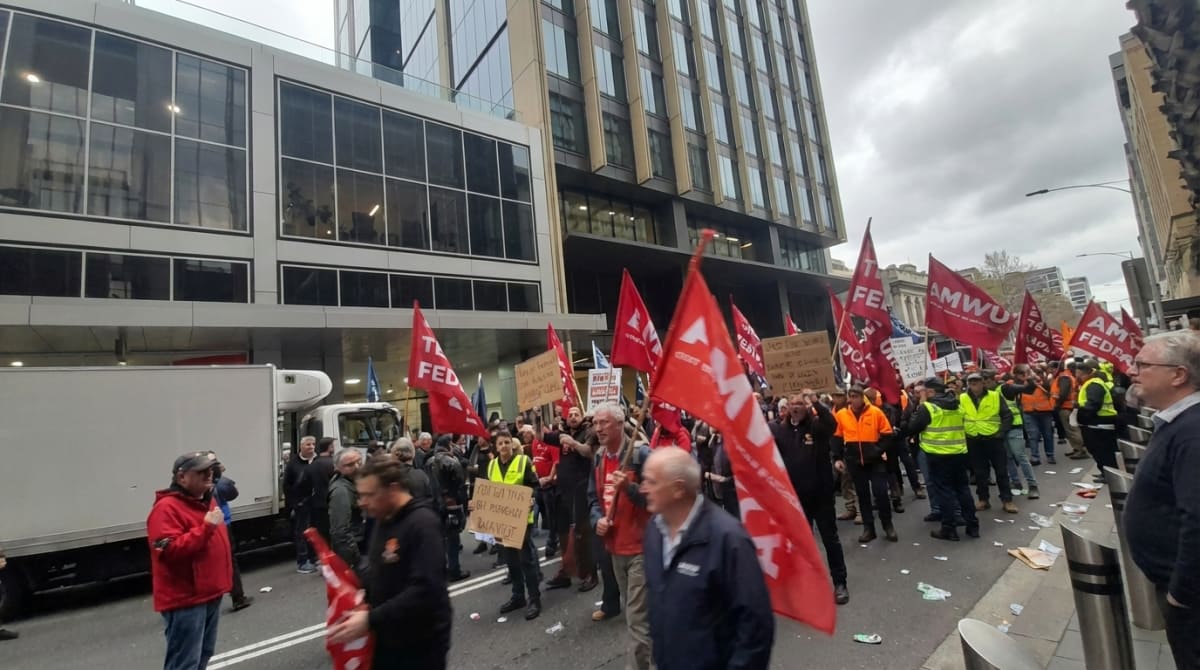
ABC staff walked off the job at 11 AM on March 25, 2026, shutting down newsrooms across the country for 24 hours in the first strike at the national broadcaster in two decades.
KEY TAKEAWAYS
Nearly 1,000 workers took part in the protected action ballot organised by the Media, Entertainment and Arts Alliance (MEAA) and the Community and Public Sector Union (CPSU). Over 90% voted in favour of striking. A separate vote saw 60% reject management's latest enterprise agreement offer.
The rejected deal offered a total pay increase of 10% over three years: 3.5% in year one, then 3.25% in each of years two and three. On top of that, a one-off $1,000 payment. That payment would not be added to base salary, would be excluded from superannuation contributions, and would not go to casual employees.
Australia's annual inflation rate hit 3.8% in January 2026. The year-one offer of 3.5% sits below that figure. Years two and three, at 3.25% each, fall further behind if inflation holds or rises.
Put plainly: the ABC is asking its journalists and production staff to take a real-terms pay cut in every year of the proposed agreement, then thanking them with a grand that vanishes from the payslip the moment it lands.
"Fearing for your own job"
MEAA CEO Erin Madeley framed the walkout as a last resort for workers stretched thin.
"ABC staff are taking this step because they want fair pay that keeps up with the cost of living, genuine job security, and working conditions that allow them to continue serving the Australian public with integrity."
Madeley pointed to workloads and career stagnation across the broadcaster.
"Experienced journalists and media workers are being asked to do more with less, with fewer opportunities for pay progression, less certainty about their future, and growing workloads."
She warned about the consequences for regional coverage, where the ABC is often the sole newsroom in town.
"When skilled, experienced staff are forced out, communities lose trusted local voices, particularly in regional Australia where the ABC is often the only local newsroom."
Michael Slezak, an ABC journalist and co-chair of the MEAA ABC National House Committee, put a finer point on what job insecurity does to editorial independence.
"How can you possibly report without fear or favour when you're fearing for your own job?"
Slezak's question lands differently inside a public broadcaster whose entire mandate rests on fearless, independent reporting. A workforce worried about redundancies and falling pay is a workforce less likely to chase stories that make powerful people uncomfortable.
AI at the bargaining table
Pay is not the only fight. The MEAA and CPSU want explicit protections against artificial intelligence replacing journalists, along with safeguards for editorial integrity. The demand reflects growing anxiety across the media industry about AI-generated content displacing human reporters, editors, and producers.
The International Federation of Journalists (IFJ) backed the strike, saying it "stands in full solidarity with the MEAA."
For the unions, the AI clause is not a hypothetical. Newsrooms around the world have already cut staff and replaced functions with automated tools. Locking in protections now, before the technology is deployed at scale inside the ABC, is the strategic play. Waiting until after the fact hands all the leverage to management.
Management's response
ABC Managing Director Hugh Marks called the rejected offer "sustainable and financially responsible." Marks has begun filing with the Fair Work Commission for mediation.
"Sustainable and financially responsible" is the kind of phrase that sounds reasonable in a boardroom and lands like a slap to someone whose grocery bill went up 3.8% last year while their pay rose 3.5%. The $1,000 sweetener, structured to avoid flowing into superannuation or reaching casuals, does not close the gap.
The Fair Work Commission mediation could take weeks. In the meantime, staff have returned to work after the 24-hour action. Whether further strikes follow depends on what Marks brings to the table.
The numbers
A 90%-plus vote in favour of action is not a narrow margin. It is near-unanimous. The 60% vote against the enterprise agreement offer tells a similar story: a clear majority of the workforce looked at the deal and said no.
Nearly 1,000 staff took part in the ballot. The ABC employs roughly 4,000 people across the country. That means a substantial portion of the workforce, concentrated in editorial and production roles, is prepared to walk out again if the next offer does not move.
Twenty years without a strike is a long time. ABC staff are not historically a militant workforce. The fact that they voted overwhelmingly to down tools tells you something about how far conditions have slipped.
The question now is whether Fair Work mediation produces an offer that matches inflation, protects jobs, and addresses AI. If it does not, Erin Madeley and the MEAA have already shown they can mobilise. The next walkout will not take 20 years to arrive.
TLDR
ABC staff staged a 24-hour strike on March 25, 2026, the first walkout at the national broadcaster in two decades. Over 90% of nearly 1,000 workers voted for action after rejecting a 10% pay rise over three years that falls short of Australia's 3.8% inflation rate. The unions also want protections against AI replacing journalists.
SOURCES & CITATIONS
FREQUENTLY ASKED QUESTIONS